


Lecturer Profile
講師プロフィール
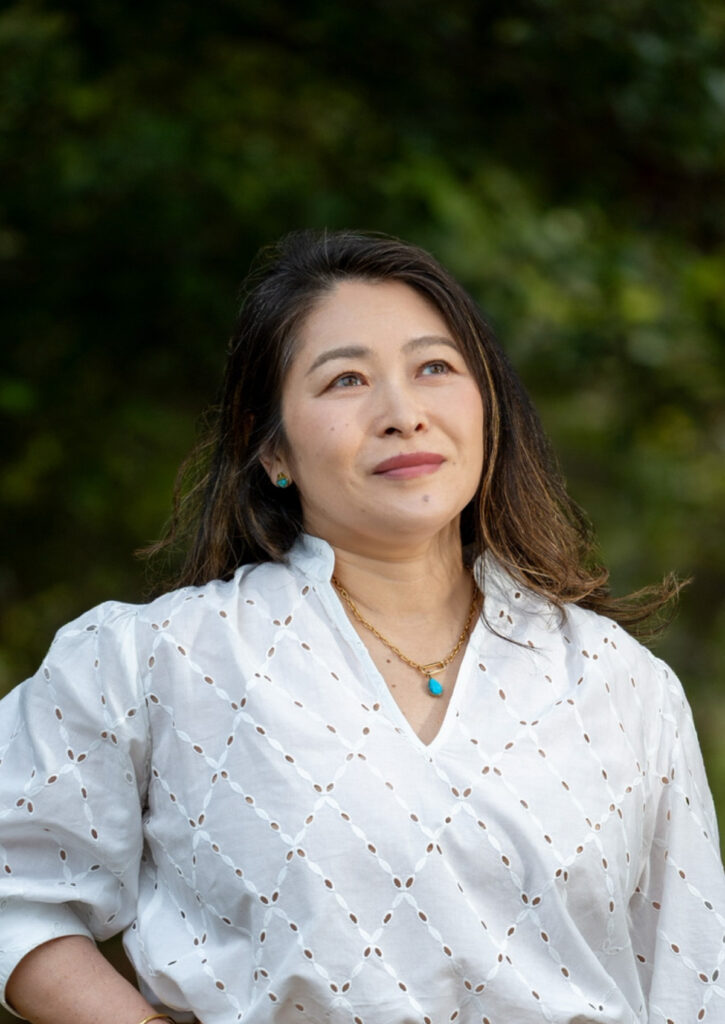
Lecturer Profile — Michi Shimura
Founder of Kotoba no Niwa
Japanese Language Educator | Guide to Words and Literature
With over 25 years of experience in Japanese language education, I offer more than lessons — I offer a journey into words, hearts, and quiet inner growth.
The story below is not just about my work —
It’s about how words can shape a life.
Table of Contents
- Who I Am | I Thought I Was Teaching Language — But I Was Nurturing People
- Inner Shifts Through Language | As Words Deepen, So Does One’s Way of Being
- Finding Freedom in Language | A Freedom That Shapes the Way We Live
- Language and Literature | Letting Literature Shape the Depth and Freedom of Language
- Words That Take Root | Words Are Seeds of the Heart
- The Landscape of Language | When Language Changes, So Does the Landscape of Your Life
- About Kotoba no Niwa | Kotoba no Niwa Is a Place Where Language Grows Quietly
- A Path in Language Education | Rooted in Words, Grown Across Cultures
Who I Am
I Thought I Was Teaching Language — But I Was Nurturing People
At the age of 23, I came to the United States to begin teaching Kokugo (Japanese language and literature) at a full-time Japanese high school.
Since then, for over 25 years, I have dedicated myself to Japanese language education across a wide range of institutions — universities, community colleges, language schools, cram schools, weekend programs, the Japan Foundation (Los Angeles), and public elementary immersion programs — throughout several states in the U.S.
Regardless of the setting or student profile, teaching Japanese has never been, for me, simply about vocabulary and grammar.Nor is it only about achieving accuracy or fluency.
What matters most is understanding the person behind the words:
Where are they coming from?
What are they trying to express?
What kind of gaze lies behind the language?
To me, the heart of language education lies in nurturing not just words, but the feelings, culture, and perspectives that live beyond them.
Inner Shifts Through Language
As Words Deepen, So Does One’s Way of Being
I’ve worked with countless learners over the years. And what I’ve come to believe deeply is this:
As one’s Japanese grows deeper, something begins to shift — The tone of their voice, the way they look at others, even the rhythm of their gestures starts to quietly change. These inner shifts gradually become a kind of “linguistic presence”—a quiet power that others begin to feel.
And before long, that transformation extends even to moments when no Japanese is being spoken. It shapes how one is, not just how one talks.
On the other hand, when words fall flat or feel unconvincing, it often reflects that the speaker’s way of being hasn’t yet caught up with their language.
That’s why I believe in nurturing not only what we say, but how we are when we say it. When one’s attitude and actions are aligned with their words, language begins to carry a kind of soul. It starts to move people.
And in time, those words shape the very foundation of who you are becoming.
Finding Freedom in Language
A Freedom That Shapes the Way We Live
Through my years living in the United States and learning English myself, I’ve often experienced a quiet frustration — that feeling when none of the words I knew quite matched how I actually felt.
I knew what I wanted to say, but all I could do was reach into my small drawer of vocabulary and pull out words that always felt just a little off. And because I couldn’t express it fully, my worth didn’t come through. My thoughts arrived only halfway.
In those moments, I felt as if I were no longer myself.
That’s why I want to help learners develop the ability to choose words that genuinely match how they feel.
Because when you can choose your words with intention, it’s not just about improving your language skills — It’s about cultivating new perspectives, building deeper relationships, and opening up new futures.
To choose your own words is to choose your own way of being.
Language and Literature
Letting Literature Shape the Depth and Freedom of Language
I majored in Japanese literature—classics, modern prose, and especially poetry. In particular, I focused my research on modern verse.
To read a poem is to immerse yourself in a sea of silence and space. Between the lines, you begin to feel the breath of the language, the quiet presence of the poet’s life, and the atmosphere of the time in which it was written.
Through countless encounters with poems and stories, language has shaped my sensibility and made me who I am today. I know from experience — words can change the course of one’s life.
To read literature is not to search for a single “right” interpretation. It’s to listen to the rhythm of a time, to feel a way of life, to gently perceive value systems you may never have encountered before.
In my lessons, I cherish that kind of diversity in how we feel and respond — and I try to honor the resonance and space within words.
Like poetry:
the ability to feel emotions hidden between the lines.
Like essays:
the courage to put your unfiltered self into words.
Like stories:
the capacity to place your heart within another’s life, and hear the story behind what is spoken.
I’ve always tried to weave this kind of sensitivity as language into my Japanese teaching,
in quiet and natural ways.
Words That Take Root
Words Are Seeds of the Heart
There was someone I loved deeply. One day, he said to me:
“Anyone learning budō outside of Japan must also understand the Japanese language.”
He was a true martial artist. His words, quietly spoken years ago, fell gently into my heart. I didn’t even realize at the time—but the seed he planted took root, and slowly began to grow.
He is no longer in this world. But that seed has lived on inside me, growing strong and tall over the years. Now, it’s ready to bloom.
And that bloom is my program: “Budō and Kotoba.”
Words live on. Words that become seeds of the heart can survive for years — centuries even.
Yamato-uta is born from the seeds of human hearts, and becomes the countless leaves of words.
— Ki no Tsurayuki, Kokin Wakashū, Preface
Written over a thousand years ago, this line still breathes within me today — and I believe it will live on, far into the future.
It is my sincere hope that the words you speak will one day become seeds — for someone else, or something unknown — and that they may sprout, grow, and blossom
into something beautiful.
The more you learn Japanese, the more you’ll realize its profound depth. It’s a language where even silence carries meaning. A single particle at the end of a sentence can express a subtle emotional nuance you didn’t know how to say.
To study Japanese is to expand your way of seeing. And if you’re already a student of budō or a traditional geidō art, perhaps you’ve already felt that truth for yourself.
To understand and express language is to touch the very roots of the path you walk. It’s not simply support—it’s a way to deepen the dō itself. That is what I believe.
The Landscape of Language
When Language Changes, So Does the Landscape of Your Life
The way we see the world — the “landscape” of our lives — often shifts with the words we encounter or use. Since I was very young, I’ve had a kind of sensitivity — sometimes conscious, sometimes not — toward the power of words. Some people are shaped by music, art, or sports. For me, it has always been words: a phrase I read, a line from a song lyric, something said in a letter, or even a message that had no words at all.
These have touched the folds of my sensibility and deeply shaped who I am. Sometimes, I’ve been hurt by a simple, thoughtless comment. Other times, I’ve cried because of careless words spoken without sincerity of heart. But just as words have wounded me, they have also carried me forward. There were moments when a single sentence — unexpected, quiet, almost whispered — gave me the courage to take the next step.
Some words arrived like soft lights in the dark, reminding me of strength I hadn’t yet recognized. They didn’t change the world, but they changed how I stood within it. Those words have stayed with me, quiet but steady, shaping the path ahead.
That’s why I believe this so deeply:
Words hold power.
And those who use them carry responsibility.
As someone who speaks, writes, and teaches language, I’ve carried this truth with me as I’ve walked alongside my students, learners, and loved ones.
Words are not just tools. They’re more like lenses—ones that gently shift the way we see ourselves and the world around us.
And sometimes, language stirs a quiet wonder — not loud or showy, but real enough to change something deep within us.
To choose your words, to change your words — is to begin rewriting the story of your own life.
I want to be a quiet companion on that journey — a guide, a gardener, someone who walks beside you as you learn to believe in your own voice, and tend to it, with care.
About Kotoba no Niwa
“To grow language is to grow the self.” This is the foundational belief at the heart of Kotoba no Niwa — the Garden of Words.
Here, there is no need to compare yourself to others. It is a protected space, like a quiet garden, where small “noticings” and gentle “shifts” are nurtured with care.
More than speaking correctly, I want to help you speak in your own voice. To learn Japanese not just as a system, but as a way of seeing — with your culture, your sensitivity, and your spirit included.
If you’re looking for a kind of learning that is quiet yet deeply rooted — this is a place I hope you’ll feel drawn to.
In this world, we are surrounded by words meant to transmit. But beyond them, there are also words that simply arrive — that sink in, and stay with us.
These are not born of technique or precision. They arise from something deeper:
a sincere gaze that truly sees another person.
Kotoba no Niwa is a place to meet that kind of language. Where words are not just knowledge, but resonance. Where language doesn’t just inform, but touches something inside you.
And so, I continue tending this garden of learning, quietly pouring water, day by day.
A Path in Language Education
Rooted in Words, Grown Across Cultures
I’ve had the privilege of walking with learners of all ages — from small children to adults in their 80s—across a wide variety of learning settings. While they may have believed they were learning from me, the truth is that I have learned just as much — if not more — from them. Each learner has planted a seed in me — seeds of insight, patience, curiosity, and compassion. These seeds have quietly taken root over time, shaping who I am today as a teacher and as a person.
I carry those seeds with me still — tending them with care, and meeting each new learner with the same sense of gratitude and wonder.
With gratitude,
Michi Shimura
Education & Background (Overview)
A long-standing career in Japanese language education across the U.S.
Teaching experience across five U.S. states:
Tennessee, South Carolina, California, Florida, and Georgia
Extensive work with:
university, community colleges, language schools, weekend Japanese programs, academic preparatory schools, the Japan Foundation Los Angeles, and public elementary immersion program
Academic background in Japanese literature, with a focus on classical and modern poetry
Holds a certified teaching license in Japanese language and literature (Kokugo)
Master of Education (M.Ed.), with research focused on multicultural education and intercultural understanding
Experienced in working with:
heritage language learners, corporate clients, and budō (Japanese martial arts) practitioners
Kyūdō (Japanese archery), 3rd Dan